Donaueschinger Musiktage 2026: Elza Loginova on Brigitta Muntendorf’s Last Show
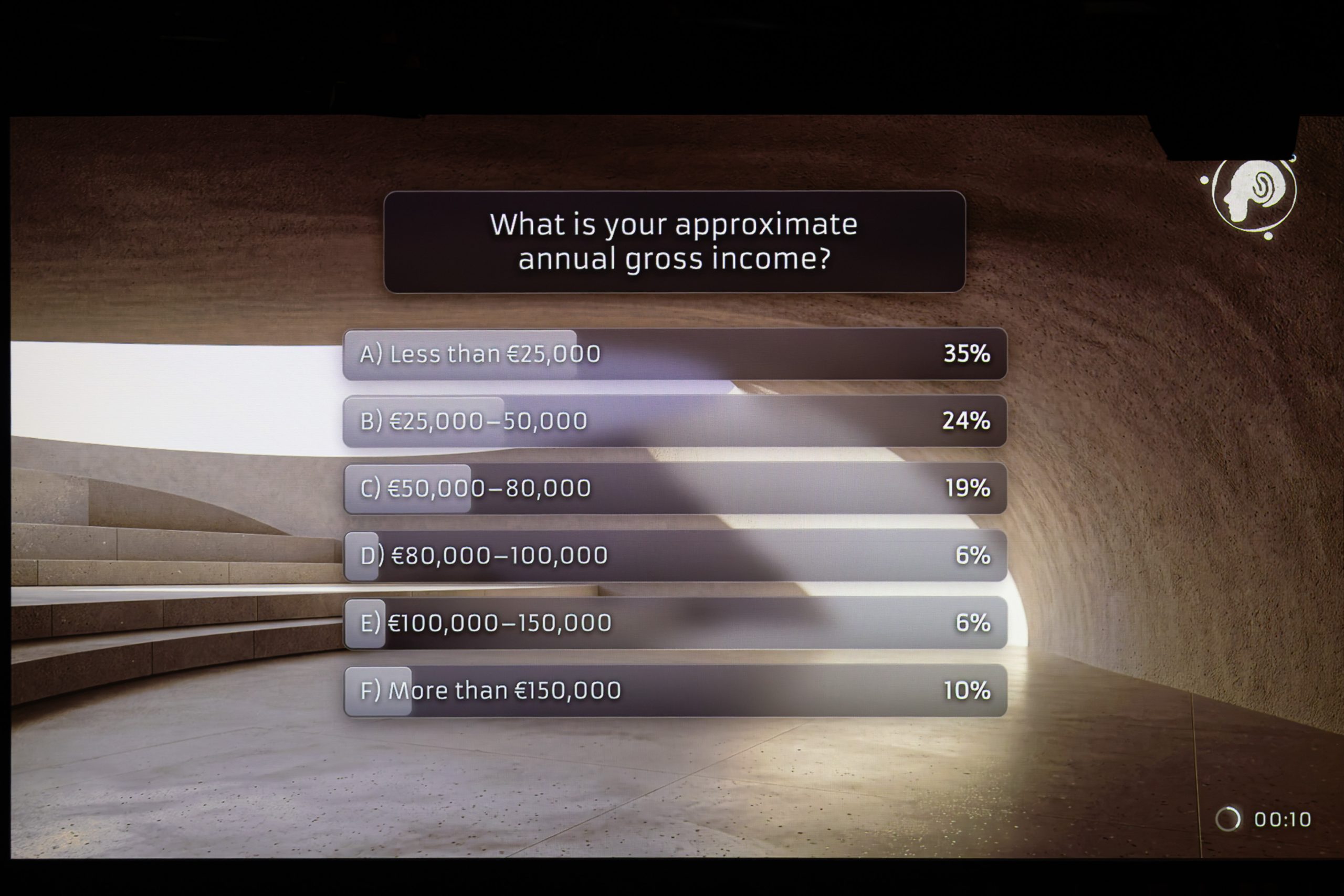
‚Without the listener, there is no concert,‘ a robotic voice informs us at the start of Brigitta Muntendorf’s Last Show. Paradoxically, this is also the moment when the concert slowly begins to lose its audience.
We are sitting in the enormous Mozart Saal of the Donauhallen, which is full of people. We are given instructions on how to connect to an internal network that is intended to unite the entire audience through a voting system. The listener is no longer expected to remain a passive observer; rather, they are encouraged to actively participate in what Muntendorf refers to as ’social composing‘. Through this, we should feel included in a special community, almost like a religious experience.
But establishing a connection is the first problem. Some people cannot access the system. Some have phone issues, some don’t have a phone and some simply don’t want to participate. Later, the technical failures become more serious. The technology that was supposed to connect the audience actually begins to divide it instead. It may be the composer’s intention to break this connection, but no connection failures occurred during the dress rehearsal of the piece.
Simply having a phone in our hands changes the way we listen. The device that is supposed to make us more attentive participants simultaneously becomes a distraction.
Most of the communication happens in English. Subtitles are provided for those who do not understand it. However, the subtitles appear in white at the very bottom of the large screen. In a relatively flat hall, they are simply invisible to a large proportion of the audience.
This concert was intended to be a social composition event in which the audience had a significant degree of agency. However, our role is mainly to answer questions. We don’t actually create the musical material, nor do we directly determine the form. We are closer to respondents in a sociological survey, and normally we should be paid for it. If it could be considered an attention hook, it would be much more akin to a method of early music pedagogy than to creating an elegant dramaturgy. Good art does not necessarily force attention; it creates the conditions in which I want to give my attention voluntarily.
Initially, we are reassured that our answers are anonymous and that the data will not be stored. Later, the same artificial voice informs us that the data will be processed. I believe this contradiction is intentional, referencing the way digital environments repeatedly promise us privacy while still turning our behaviour into data.
This reminded me of a production of The Magic Flute in Freiburg in 2023. There, too, the audience was given the illusion that they could influence the course of the theatrical event. And there, too, a conflict emerged between attention to the screen and attention to the performers. Despite the desire to approach participation in a new and perhaps more honest way, the same problem remained in Last Show. We watched each other’s screens more than we paid attention to the performers.
There were musical moments that genuinely fascinated me. I especially liked Muntendorf’s treatment of the robotic voice — a processed singing voice that seemed to exist somewhere between AI, Björk, the uncanny valley, and folk music. A single voice suddenly became a duet with itself. Towards the end of this passage, the voice descended towards the repeated word ‚human‘, until only the drums remained. This was a simple gesture in which the technological and the human suddenly confronted one another.
However, a significant issue arises regarding the musical material, as we are confronted with previously published music. Musicologist Rosa Bandera, who works for the 2eleven company, has made an interesting discovery: a substantial piece of music, which was commissioned for the same film three years ago, was performed twice during the concert. The same applies to other material, referring to an earlier piece called ‚Weight and Load‘. So, I only have to ask: what proportion of the music is actually new, and should we call it a premiere, or are we dealing with massive self-quotation, collage or perhaps just recycling?
When I ask myself whether the concept of the piece worked, I cannot give a direct negative answer. The boundary between composed participation and the real social behaviour of the audience had become so unstable that people were no longer sure where the work ended.
The listener did not become an agent by pressing one of the buttons offered by the interface. The listener rather became an agent by refusing to participate. By leaving the hall. By overwhelming the server collectively. By laughing or becoming frustrated. They became an agent by applauding sincerely — or by booing the composer when she appeared on stage. If this is what is intended by social composing, we have indeed reached the point.
By Elza Loginova