Donaueschinger Musiktage 2026: Christian Gregori on Marina Rosenfeld’s XY
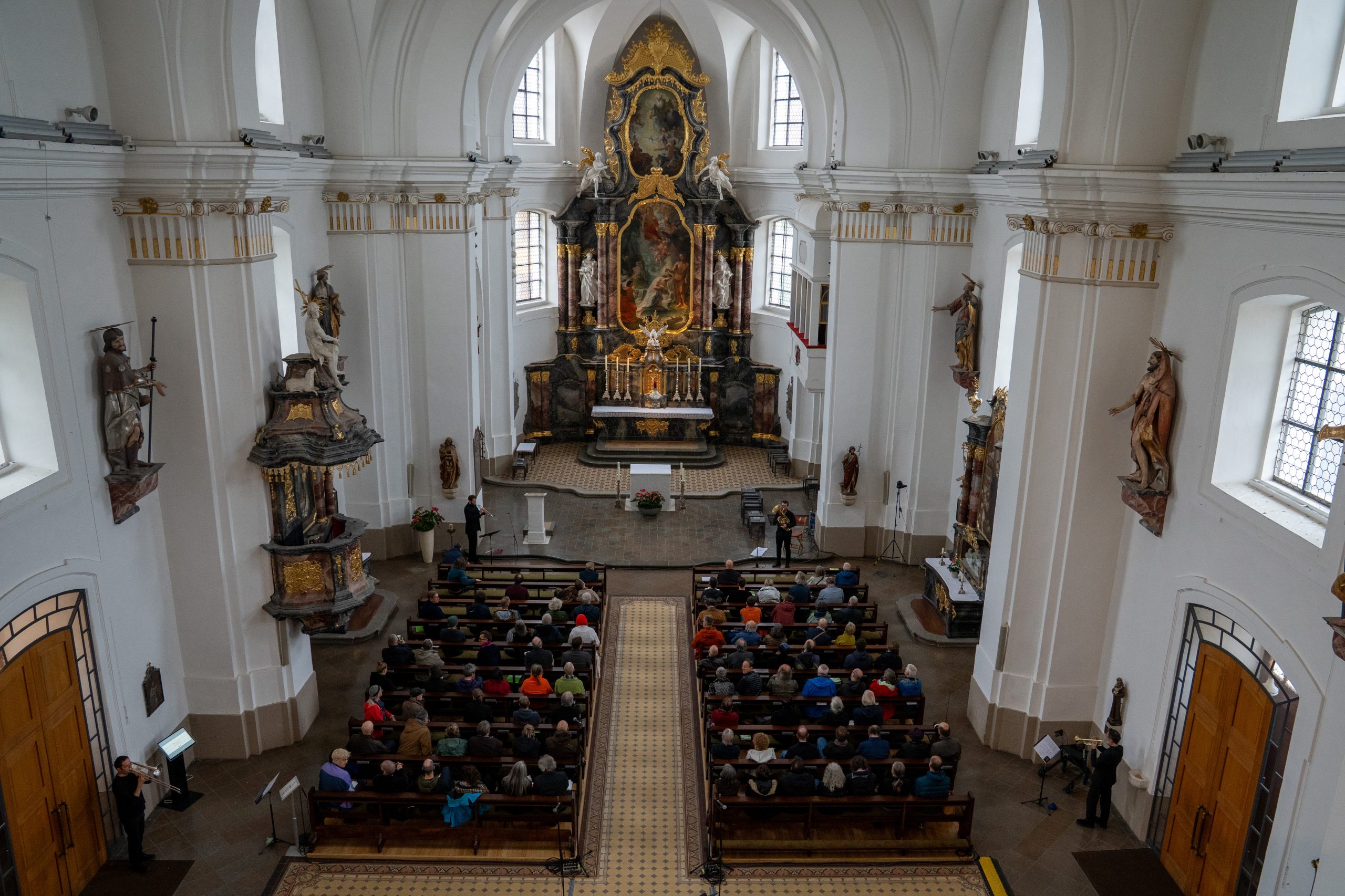
With a church hymn book in front of me and the yearning gaze of Apostle Simon the Zealot upon me, I sat waiting, having already been questioned on the subject of religious transcendence by Eliane Radigue’s Occam XXV Zeta. Starting with a single high organ note, Marina Rosenfeld’s XY begins with a similar idea to Radigue’s, but at the opposite end of the register. For a moment, I felt uneasy – transcendence is rarely achieved by repeating an established idea.
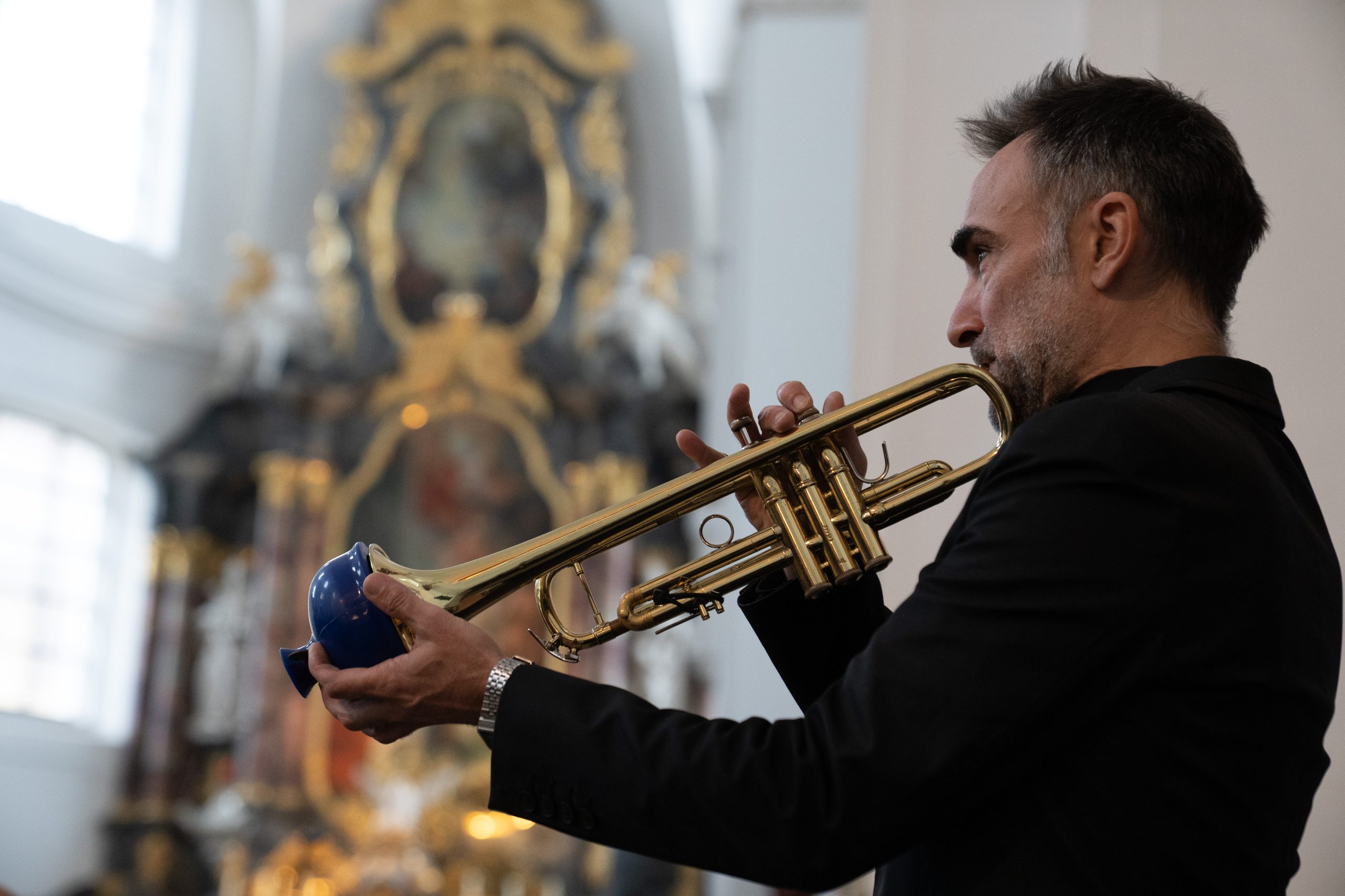
But shortly after the six brass players joined in, who were evenly distributed throughout the church, just beneath the wooden figures of the apostles – were they beginning to proclaim the Gospel, or embodying the trumpets of the Apocalypse? Their soft breath seemed to rise along the walls, the sound settling over me like warm, brassy fog. Rosenfeld has given them considerable freedom but they mainly react to their counterparts on the opposite side of the church. A web of sonic references opens up, in which the players‘ clear symmetry dissolves into resonance. It is never quite clear where the sound came from, but their mingling together makes the church sound itself. Meanwhile, the hidden organ continues to add its own material, creating binaural beats. Gradually, the intensity increases. Mutes and preparations are used to create sounds rich in overtones, especially with the euphoniums, which are played with a toy hose to create a fascinating sound resembling white noise more than that of a conventional instrument. At the highest intensity the materiality of the sound is so rich that an imagined sculptural quality emerges. Resonance becomes a mediation of space, made visible to us through our ears – almost like the casting of an antique sculpture, but with sound instead of bronze. The sound sculpture drops and shatters in an instant, and silence gives way to the negative imprint of the space. This crescendo is repeated two more times before the piece ends. While the overall sense of movement remains unchanged throughout the sections, the material itself varies slightly in colour, shifting from scalar playing to tremolos. However, the abstract quality of space remains.
Alongside the crescendo as triangular sculpture and silence as a radical other, there is also a third sound figure: the point. In the beginning, the middle of the second crescendo and at the end, the brass players form duos playing a steady rhythm on claustrophobically tiny wood-blocks. There is almost no audible resonance, just an abstract point. Rather than escaping the space, they seem to suspend its acoustic presence, leaving a negative imprint of the church resonance. Their placement at the beginning and end of the piece alludes to the cyclical nature of its form. Meanwhile, the interruption of the second crescendo divides the piece into symmetrical halves, mirroring the placement of the brass players. Unlike at the beginning and end, the three duos do not play simultaneously here, but one after the other, reflecting the three-part form of the crescendo sections.
Taken together the crescendo sections and the connecting points make for an interplay of formal layers, mixing cyclical ideas with three movement form and parallel mirroring. A visual representation of this would surely look more like an alchemical sign than a music-formal diagram. In XY, the focus is not on traditional form, but on a higher degree of abstraction, where the numerical and symmetrical relations of the form are imagined visually.
Duality lies at the core of XY, evident in the musical composition, the visual arrangement of the duos, and the use of musical imitation, as well as in the ontological duality between materiality and form. This interplay is less like a conventional musical process and more like an image forming in the mind’s eye. In this sense, the piece is more akin to sound art than to musical composition. However, rather than opposing sound art and musical composition, XY blurs the boundaries between the two. The abstract visuality of form and materiality interacts with the performers‘ movements and the visuality of the space itself. This is definitely a site-specific piece, one that should be played in a church, in which the empty meaning of abstract form gives rise to century-old symbols: the cyclical form brings eternity, the three part movement bring in the holy trinity, the brass are only missing one player to be the seven trumpets of the apocalypse – but maybe the organ is the seventh? The piece is not about Christian symbols, but it is quite aware that it could borrow these semantic meanings from the inherited space and it does so playfully. It is no wonder that immersion, which the piece clearly engages with when the brass players fill the room with music in such a strength that you feel like breathing in music everywhere around you, comes from the ritual. But perhaps abstraction comes from the ritual as well?
-
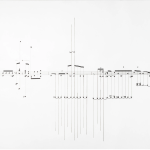
- Excerpt from Deathstar (Notation), Frankfurt, 2017 © Marina Rosenfeld
-
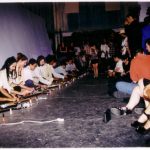
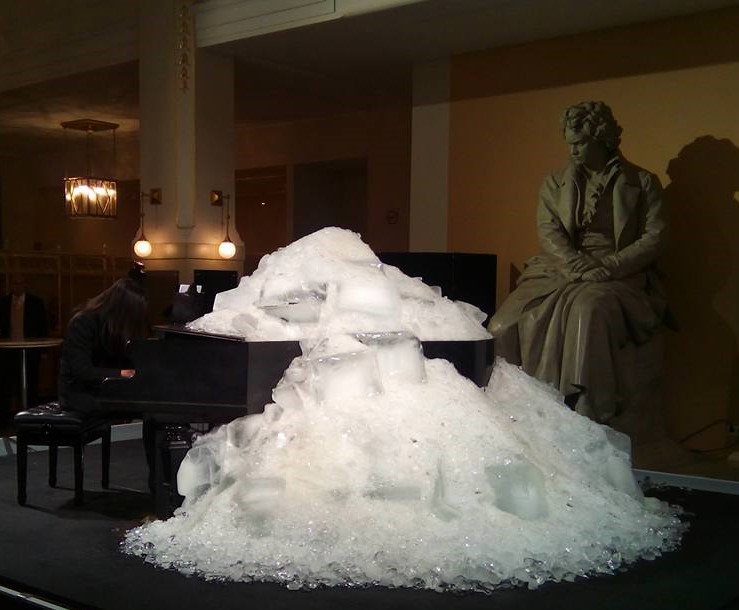
- The Sheer Frost Orchestra, Greene Naftali Gallery, performance view with Beth Coleman, Kembra Pfahler, Marina Rosenfeld, Brooke Williams, others, New York, 1997 © Marina Rosenfeld
-
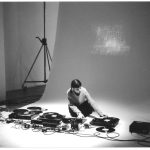
- Performance theforestthegardenthesea, Vienna, 1997 © Marina Rosenfeld
This entanglement of sound, visuality and space is not incidental to XY, but rather resonates with broader tendencies in Rosenfeld’s œuvre. Boundaries between sound art, performance and composition are constantly renegotiated. In The Sheer Frost Orchestra a collective feminist performance gives rise to a visual line, in Deathstar (Notation) the score itself becomes the focal point of visual attention and; in her work cycles and turntablism, the cyclical nature becomes addressed. XY brings these concerns into a concentrated relationship with architectural space, its resonance and semantics.
In her thinking, and especially in XY, sound, visuality and spatiality are so intertwined that ignoring one would completely alter the delicate balance between abstract form and concrete material. In this respect, Rosenfeld presented the most formally coherent piece at this year’s festival, as well as the most sensual performance.
by Christian Gregori