Donaueschingen 2026: Dana Borić on Steen-Andersen’s UR!
We all arrived on time for the dress rehearsal, while Steen Andersen and the technical crew were setting up the lights on and around the stage. Yellow stage lights focused on the center of the stage, while cheetah-like light patterns were projected onto two large partition screens on either side of the audience. Steen-Andersen then apologized for the inconvenience, explaining that we would have to wait another 30 minutes before they could begin the rehearsal. He also acknowledged that the piece itself was unfinished and still a work in progress. I personally found the rawness and honesty of the situation refreshing. It was a real-time glitch in the production process.
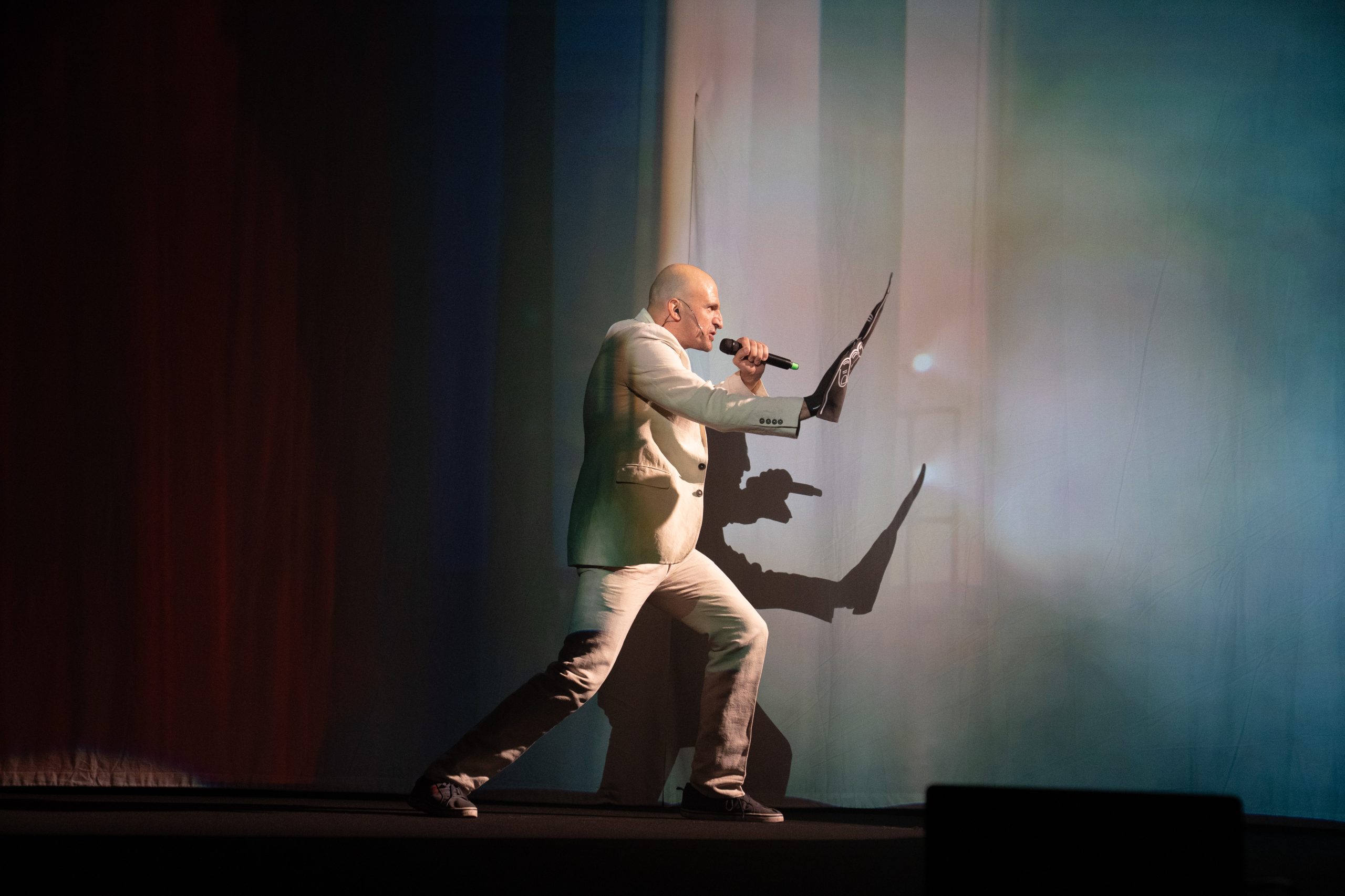
When Steen-Andersen and the crew finally began the rehearsal, he told us to “imagine” the yellow lights slowly fading out. Then, suddenly, the lights went off. Steen-Andersen’s new piece, UR!, performed by Michael Schmid, is a stage and video performance that brings together different historical, biographical, and aesthetic dimensions. From the very beginning, the boundaries between stage and cinema, live performance and pre-recorded material, as well as stage and backstage, remain fluid and are constantly recontextualized. Steen-Andersen plays with the repeated performances of Michael Schmid reciting the sound poetry piece Ursonate by the Dada artist Kurt Schwitters.
The timeline of the piece unfolds through constant repetition, gradually revealing and expanding the narrative details for the audience. As the piece progresses, we continually revisit what we have previously perceived, allowing the real-time present and the recent past to become entangled. This temporal structure is directly connected to the history of Ursonate, which Schwitters first performed in 1925 and continued to develop until its publication in 1932. The sound poem consists of primordial language sounds, exploring rhythm, noise, and timbre through repetition and fragmentation. Although the poem is an absurd exploration of vocality, it is generally structured in sonata form. This raises the question of whether Steen-Andersen not only employs repetition and fragmentation in his piece but also references sonata form in the overall structure of UR!.
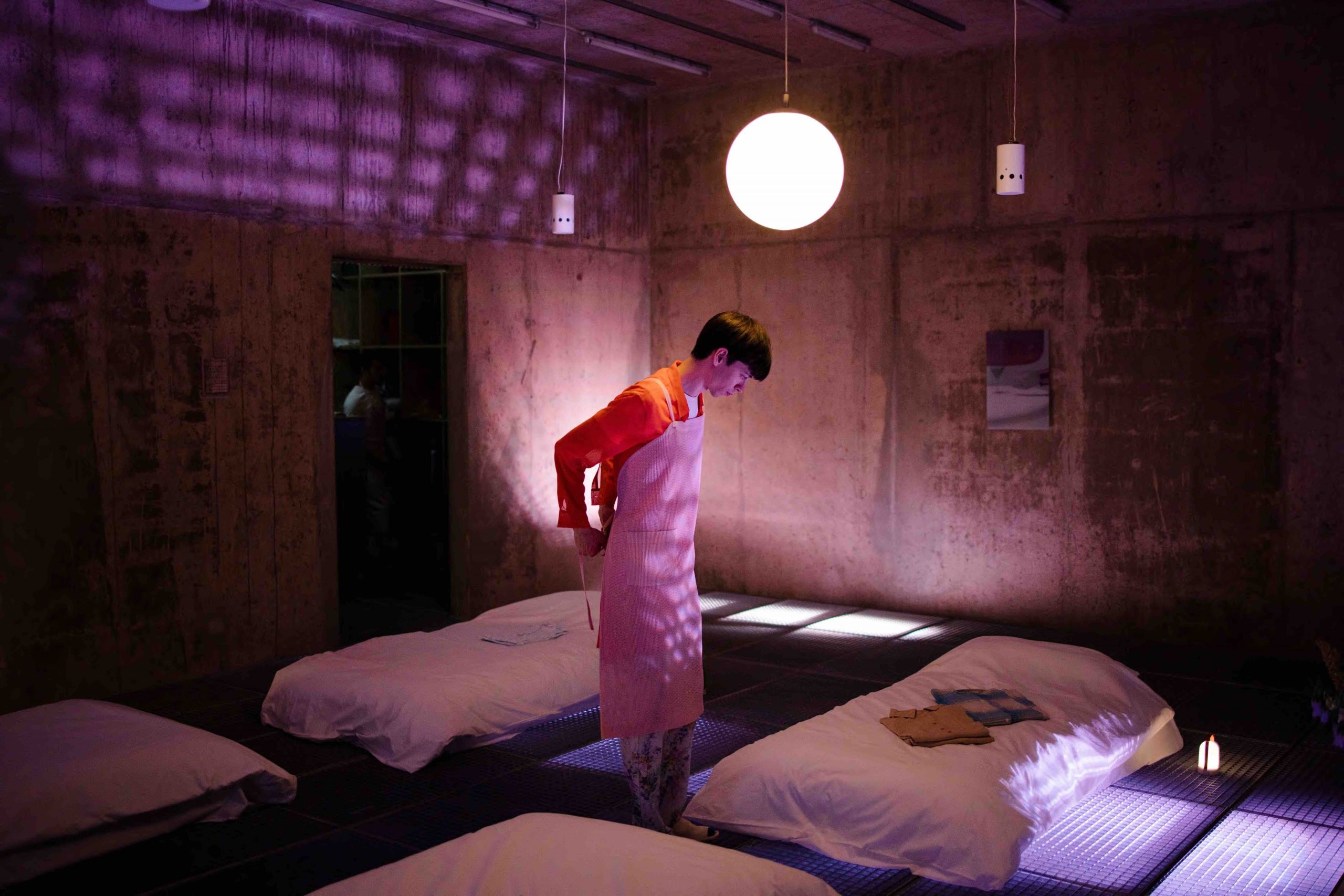
Schmid’s character shifts between exaggerated performativity, as he performs Ursonate with a large blue foam finger on his hand, and the persona of someone trapped in a repetitive backstage nightmare. A god-like voice, which gradually takes on the role of a therapist-shaman, guides Schmid through what he calls a “cave system” backstage, perhaps analogous to a person’s subconscious. This brings the performance’s cyclical timeline and narrative into the realm of surrealism, which differs fundamentally from Dadaist ideas. Michael repeatedly dreams of the same nightmare scenario: preparing to go on stage and getting lost on the way, while being followed by a bear and an unidentified man in a long coat. As the filmed material becomes increasingly surreal, it also begins to reference Dadaist visual practices, such as collage and photomontage. These varied visual references create an interesting mixture of historical and fictional storylines, keeping me curious and engaged throughout the piece.
Although I have yet to see the piece in its entirety, I believe UR! offers an interesting exploration of the relationships between performance, documentation, and fiction. I am curious to see how these elements will develop in the finished work. As Schwitters proclaimed, “Merz means creating relationships, preferably between all things in the world!”
by Dana Borić