What was the Voice in New Music? Or: How to Raise Our Voice?
This is an edited transcript of the lecture, held on October 16, 2025 in Donaueschingen as opening lecture of the NEXT GENERATION programme at the Donaueschinger Musiktage 2025. It is attempted as a musical variant of Chris Cutrone’s Capital in history: The need for a Marxian philosophy of history of the Left (2008), and the reading might profit from its accompaniment.
This year’s Donaueschingen festival edition is about Raising the Voice. I want to reflect with you on what that means and how this is possible.
The voice is at the same time the most musical and the most unmusical instrument.
It is the most unmusical instrument because it brings to the realm of music all the extra musical world. With the voice mostly comes a text, with it comes the presence of the human body and thus a scenic and visual dimension, and with the body comes a person, someone the voice is the expression of.[1] And that someone the voice is the expression of constitutes also someone who is addressed by this expression – us, the audience.
It is also the most musical instrument, because all music is considered a substitution for the voice. In an instrumental piece all voices are voices. In that way, all music is considered song, because all music is the expression of human subjectivity [2]. Some songs just are songs without words, Lieder ohne Worte. Even Spotify, our industrially administered musical unconscious labels every piece of music a song: If I play Luigi Nono’s 1979 string quartet Fragmente – Stille, An Diotima on Spotify, it is listed as my favorite „song“.

Luigi Nono – Fragmente-Stille, an Diotima (1979-80) per quartetto d’archi – YouTube
The issue of the voice is thereby entered through the backdoor: This is not a piece for voice, but an instrumental piece of chamber music. It also is not composed in a vocal manner, it is polyphonic, but that noisy harmony of the opposites of fast tremolo figures and long held fermata notes all of them either al ponte, al tasto, flautando, some col legno battuto, and in silent dynamics, as well as the long rests make this piece antimelodic. This chamber music has no melody – it is a way of expressing the silence. It even has a text, but it is not to be heard, it just can be read in the score. It is not raising the voice in any sense. Still, I want to do justice to Spotify considering it a song.
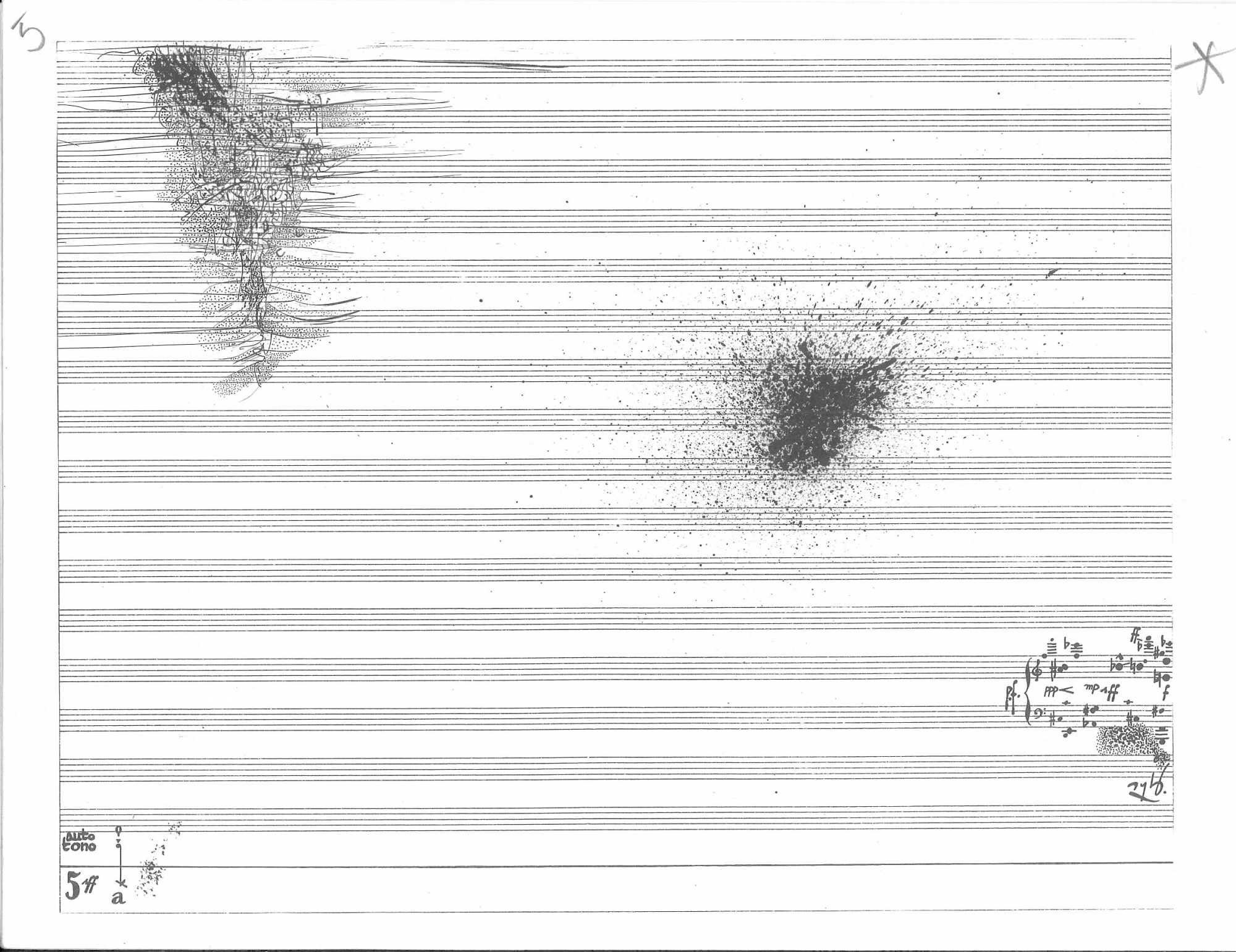
Luigi Nono, Fragmente-Stille, an Diotima per quartetto d’archi (1979–80), Partitur, Ricordi.
The first voice to be heard in this lecture is that of critic and gay-muse of many Darmstadt School composers, Heinz-Klaus Metzger. A good voice shaped by musical experience and drug abuse [translation below]:
At Nono’s suggestion, Hommel showcased the background to this [string quartet], albeit only after Nono’s death, by inviting a Sardinian peasant quartet to Darmstadt [in 1992]. So, imagine four Sardinian peasants standing together, very close together, as if they wanted to kiss, singing very quietly. Only for each other. It is not forbidden for others to listen, but it is not for an audience. In his sociology of music, Adorno emphasized that the question of whether something is chamber music or not is not a question of the instrumentation. It’s not that a piece with a large instrumentation isn’t chamber music and a piece with few musicians is chamber music. But the essence of chamber music is that it aimes more at the performers than at the listeners. And this is particularly true of authentic folk music, which has no audience. These Sardinian peasant quartets, always consisting of four men, inspired Nono to write this composition. […] And now I know that chamber music, these four musicians with equal rights and equal status, who only play for each other and can no longer be heard from a certain distance, are the people, or at least represent the people, namely the people that one would like if they finally emerged as a people, whereas what is now called the people, well, one cannot love that.
So like Spotify, Metzger considers this piece a song. But still, there is a way in which new music came to a point where this song can only be expressed in silence and fragments, in chamber music without a voice, without raising the voice – and in this precisely Metzger saw a utopian potential articulated.
So far to raise the voice as problem in the present.
To see how we got there, I’ll introduce a bit of history of the voice before new music – to which new music reacted. History, of course, is not the past, but the present. It is unrealised utopian potentials from the past, present today as task. They haunt and thus task us as the voices undead ghosts seeking redemption.
In an unpublished notebook, Adorno noted „someone who sings is not alone.“[3] This is not just kitsch. Of course, it is nice not to be alone. But it also says: we cannot be alone. In the voice the subject doubles itself, puts itself before itself and encounters itself as other. The voice thus establishes a relationship of the self to another, and at the same time to itself as another. As subject, the subject of the voice constitutes itself in this relation to another and to itself as other. In the voice the subject doesn’t just represent it’s being, but it is becoming subject in the first place as well as it only constitutes by this self-becoming the other subject and itself through the other subject. In the voice, the subjects, as well as their relation, are produced, not reproduced.
This is the impulse of the utopian character of the voice, and thus, of music: It expresses the potential of expression – the potential that human relations can take the form of conscious self-production and interpretation – and thus, of self-transformation. The voice expresses the potential for transformation, for change.
This is, of course, the situation of the modern voice. It has not been understood like that in premodern chant. In premodern music, the subjects of the voice weren’t really subjects. They didn’t produce themselves and their relation, but were produced: created – in the image of God and God’s eternal order. Song thus was not to produce, but to reproduce the human and human relations as created by God. In Gregorian chant, the voice wasn’t the expression and thus constitution of a subject, it was the expression of the Word of God. This is why in early premodern music, polyphonic music was also polytextual. Independent instrumental voices were, and are until today in some religious communities a sin. As the voice didn’t express and constitute a subject, it also didn’t address and thus constitute another. Premodern music doesn’t constitute the listener, it has no audience, but in a way the only listener is God. It doesn’t produce a performative situation; it doesn’t produce transformative social relations between humans.
In addressing the other, modern voice is about transformation. The voice is about attracting and moving the other. It aims to be beautiful. Or: to be bel. The bel canto. The bel canto is the expression of the transformative character of the modern voice. It is a technique of transforming oneself, the own voice, in order to address and transform the other – through techniques like the phrasing, the messa di voce, the vibrato and strong declamation. The voice itself becomes an instrument. The voice is not reproduction of eternal harmony, but the ever new self-production of human relations through transformative activity. Transformative activity is labor. Thus expresses the bel canto the utopia of modern, bourgeois society: freedom through labor, freedom through the transformative activity of the subjects. As the voice becomes the instrument of human self-transformation, the instruments become substitutes for the human voice.
This is what raising the voice is about in modernity. Every instance of the expressive voice produces freely human relations anew. To establish that singular and momentary relation of mutual transformation is until today the struggle, the work and the suffering of the singer, the worker that produces with its labor of singing this relation. Here are two singers, talking about their labor:
C’est magique. The magic is the incertain, ever new transformative relationship in which expressive subject and listening subject constitute each other in a singular instance.
Do you know who Inva Mula is?
Let’s listen and see:
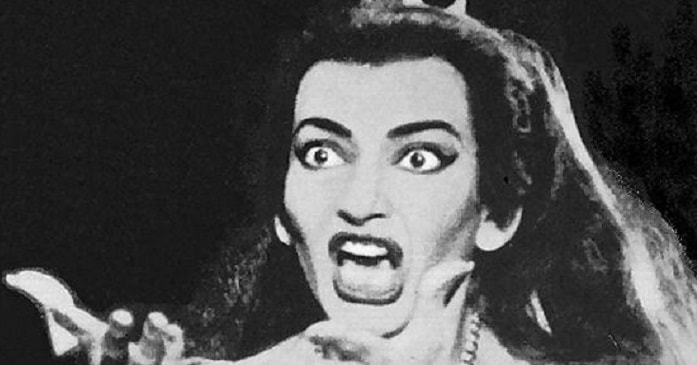
The „Diva Dance“ (acted by Maïwenn Le Besco; singing voice by Inva Mula-Tchako) in The Fifth Element (1997) by Luc Besson
In the excerpt, you also see the relationship between singer and listener. Bruce Willis, future working class hero and ex-soldier – who could be more of a guy, representing the bourgeois subject? –, is sitting immobilized in the audience, and is apparently deeply touched, moved. It reminds us of Adorno’s reading of the relation between singer and listener in the encounter of Odysseus, warrior-type guy like Bruce Willis, with the sirens, alien creatures of sexual and intellectual attraction. Adorno points to the limitation to the constitution of bourgeois subjectivity through the voice: By constituting themselves as subjects towards each other, they also seperate from each other, never really reach each other. In modern music, they are separated by the stage. This is why transcending the stage is such an issue to New Music. Odysseus can only enjoy the song of the sirens by fettering himself, keeping him from what he really wants: go to the sirens, unite with their song:
The bonds by which he has irrevocably fettered himself to praxis at the same time keep the Sirens at a distance from praxis: their lure is neutralized as a mere object of contemplation, as art. The fettered man listens to a concert, as immobilized as audiences later, and his enthusiastic call for liberation goes unheard as applause. [4]
This is very clear if you put it like this: Music has a lot to do with sexuality, but still, there’s a limitation, you can’t have sex with music, even if you really want it so much.
This is significant in the film, because after this scene they will cut out the four elements out of the body of the singer. So the singer’s body must be opened to really get to the elemental truth of the universe – the truth of the sirens. The woman with the red hair, Milla Jovovich, is the Fifth Element – quasi Love. And her name in the film is Leeloo, an elemental name like Alban Berg’s Lulu.
Very typical for the representation of music in film productions is the way it shows the separation of music and the outside world. While in the inner movement driven by the voice in the concert hall time seems to stand still, outside the action is taking place. The sphere of contemplation and inner movement is opposed to the sphere of praxis and violence. In opera, this was the opposition of aria and recitative, passio and actio, the productive tension of theory and praxis.
But, what we can hear in the second part of the „Diva Dance“, is that after Verdi’s characteristic bel canto aria „Il dolce suono“, representing the opposition of the madness of love vis-a-vis a repressive society, the voice is electronically manipulated. Inva Mula herself said the pitch changes were composed so fast, that she couldn’t sing it, so they cut her voice – which makes the bel canto voice seem an alien voice: alienated from itself.
So, the subjective relations produced by the voice become problematic with the machine. The technical perfection of the Queen of the Night is overcome. The machine produces much better results and makes the struggle of the singer unnecessary. The labor of the singer is insufficient and superfluous. And it becomes so with the introduction of the machine, with capitalism. The machine is the accumulated labor of the subjects, that overwhelmed the activity of the subjects, so that their activity, their labor becomes insufficient and superfluous vis-a-vis of their accumulated labor from the past incorporated in the machine. In Marxian language: dead labor overpowers living labor.
„Capital is dead labour, which, vampire-like, lives only by sucking living labour, and lives the more, the more labour it sucks.“ [5]
We can put this in simple terms, to not be cryptic: everybody (all of us) wants a job, but the economy doesn’t need our labor. So we need to work to live but life doesn’t need our labor. And still, everything is the product of our accumulated collective labor and social intelligence, a product which nobody seems to be happy with, though. This is then, why we want to raise our voices.
The Verdi Inva Mula sings before the post-human Queen of the Night aria, brings us to the mid 19th century, the time of the crisis of both: firstly the social relations of labor through the introduction of the machine, industrial production and thus, capitalism, and therefore secondly the crisis of the bel canto, the insufficiency and superfluidity of human transformative activity in the voice and the human relation it established. There’s a sense here in having the term fluidity in superfluidity:
In Wagner, the voice gets liquified, if not liquidated in melting into the orchestra. It gets sucked in and liquidated into the technical apparatus of the music which Wagner hides in the orchestral pit as „mystical abyss“. [6] What is hidden in the mystical abyss is the technical apparatus and the labor to produce the music, as if labor wasn’t necessary to produce the music. This is another notion of the magic. With capitalism comes into the world a new utopian potential: not freedom through labor, but freedom from labor. Not the constitution of the subjects through interaction with the other, but dissolution of the subject in the other. The Dictatorship of the Proletariat was considered the raising, the constitution of a social subjectivity that allows for the subjects to dissolve, to overcome the limitations of the bourgeois self, disciplined by labor. Nietzsche articulated this as the Dionysian: the greatest self-achieved property of the subject is to lose one-self. This is why the ever dissolving, self-destructive art of music became the art form of the Romantic era. Music in its substantial foundation, the sound, is the negation, the negation of its own substance: Other than point or written language, the musical tone only comes into existence by ceasing to exist, its being is its withering away, its appearance is its dissappearance. Every note played is dissappearing in the moment of being played, and only this dissappearance is what its appearance consists of. [7]
This is the history that New Music reacts to taking up the voice as an instrument. In order to focus on the problem of the voice and the machine, I will skip the voice in Schönberg and his School, which also is dealt with a lot, and just very rough- and dogmaticly list a few ways in which the avantgarde connected to Darmstadt after World War II related the voice and electronics.
In Stockhausens 1956 Gesang der Jünglinge the youth voices are integrated and melted into the electronics: They’re electronically modified in rhythm, dynamics, pitch and timbre/Klangfarbe to match the electronics, as well as the electronics are arranged to match and absorb the voices. The paradigm of this relation is that of the voice absorbed by the machine.
In John Cage’s Aria with Fontana Mix differently coloured graphic notation indicates different styles of singing such as Jazz, contralto lyric, Sprechstimme, dramatic, Marlene Dietrich and others. It is proposed to be performed together with the electronic piece Fontana Mix. Fontana Mix is the name of the tool Cage used to mix electronic voices. It was workshoped with Berberian, a collaboration in which Cage made use of her so called „domestic clowning“ as she always imitated different vocal styles: „a one-woman simulacrum of rapid tape“, which made her be considered in the context of the studio in Italy that had nine oscillators for electronic sound generation, the „tenth oscillator“. [8] The paradigm for the voice here is that of the voice as machine.
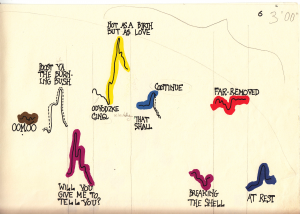
Excerpt of Aria for voice, score, C.F. Peters, Leipzig.
In fact, Berberian considered herself as an instrument. She attributed the fact that the performance of Aria in Darmstadt marked a “milestone in the history of vocal music” to the way Cage used her as an instrument: “All those creative ways of using my voice would never have come to life without John’s piece. Because I was like an instrument locked in a box. No one knew what was inside it until John opened it and started playing with some of the strings.” [9]
Luciano Berio made use of this now unlocked instrument to further open the hidden qualities of the human voice. In his 1961 electronic piece Visage, Berberians voice is, without a body, on tape. It was intentionally composed for the electronic mass media, for the radio, but then censored by the Italian National radio for being pornographic – nota bene auditory porn. And maybe the censors were right that there is a specific intrusiveness to the close recorded human voice without a visual representation, that then even gets naked when it is not covered by the costume of formalized bel canto style, but Berberians profane laughter.
Later they did it in a scenic version, with Berberian in a silent mime role on stage, gesturing and giving a body to her own voice separated from her body. Body and voice are separated and reassembled through electronics and stage. The paradigm here is that of the de- and reconstruction of subjective presence in the machine.
In his Sequenza III (1965) he radicalizes the seizure of the voice to the singer’s subjectivity itself. The piece includes a list of emotional performance instructions (Vortragsbezeichnungen), such as „dreamy“, „ecstatic“, „nervous“, „very excited and frantic“, „whistful“, or „witty“.
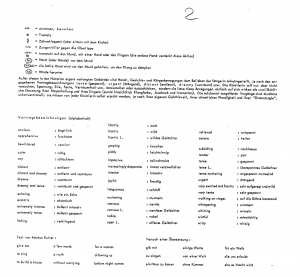
Luciano Berio, Sequenza III per voce femminile (1966), score, Universal Edition, p. II.
These emotional subjective attitudes are employed in a particularized way and in quick succession – 44 attitudes on three pages of score, many of them repeated multiple times, so that the change from „urgent“ to „tense“, to „frantic“, to „joyful“, to „tense Laughter“, to „dreamy“ is to be mastered on single musical instances and within fractions of seconds.
The piece also has a text, containing a subjective expressive dimension:
give me
a few words
for a woman
to sing
a truth
allowing us
to build a house
without worrying
before night comesLuciano Berio, Sequenza III, Text: Markus Kutter
You can never really recognize the text, only in the end, in a final vocal line pointing to bel canto. Marion Saxer pointed to the parallel of the motiv of the possibility „to sing a truth allowing us to build a house“ with the 1799 Hölderlin poem Mein Eigentum (My property) in which the poetic persona wishes „song“ to be his „friendly refuge“ („Sei Du Gesang mein freundlich Asyl“). So through the night of deconstruction of subjectivity, it is in (bel canto-)song that the subject seeks for home – „without worrying“. So even here, the bel canto singing is the instrument for subjective expression of a human hope, for the possibility of human expression within, or against the technical administration of subjectivity. The The paradigm here is subjectivity as machine with a suggestion of subjectivity against the machine.
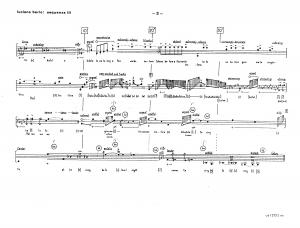
Luciano Berio, Sequenza III per voce femminile (1966), score, Universal Edition, p. 3.
Before in Nono the voice became silent in his string quartet Fragmente-Stille, an Diotima, in 1964 he still thought it might be possible to raise it in an upfront manner. La fabbrica illuminata for female voice and electronics is paradigmatic for Nonos ‚politically engaged‘ pieces. The tape contains voices from interviews with workers, noise-sounds recorded in factories, as well as the recorded voice of the singer, Carla Henius. So the tape shifts in its role from a chorus of the masses vis-a-vis the expressive subject of the live solo voice, to the dystopian, also enjoyable noises of the machines and its domination over the human voice. Like in Berios Sequenza for voice there is a kind of releasing bel canto moment. By the end, the tape is silent and the live-singer has a solo cantilena with a hopeful poetical text, that also shares motives with that in Sequenza III:
Passeranno i mattini
Passeranno le angosce
Non sarà cosi sempre
Ritroverai qualcosPass will the mornings
Pass will the fears
It won’t be thus for ever
You will find a thingLuigi Nono, La fabbrica illuminata, text: Cesare Pavese.
I don’t want to interpret that reductively, but it has a bit of the character of the live voice struggling and achieving the human position against the machine. Marion Saxer pointed out how here the bel canto becomes semantically loaded as a Klangsymbol. The vocal style of a bourgeois past before the failure of the revolutions in the 20th century symbolizes the utopia of finding the human voice again, the promise: „You will find a thing“. [10] To still uphold the utopia of the voice, Nono took recurse to the subjectivity of the bourgeois subjectivity in a per aspera ad astra development. The aspera here seems to be the dead (=no soul, no subjectivity) electronic voices, the noisy machines vis-a-vis the live (=ensouled, subjectivity) voice. The paradigm here is the (live) human voice against the (dead) machine.
Nono was himself a pioneer in the work with electronic sound, and also in emancipating the musical and phonetic qualities of the voice from the semantic functionality when employing text, as in his Il canto sospeso of 1956. But in 1965, he seems to accept the failures of the prior experimental emancipation of the voice, as conducted by his colleague Dieter Schnebel. For Schnebel, the emancipation of the voice was the exact opposite of loading it with promises of the past, but getting rid of any semantic function that subordinates the voice to any heteronomous rule, such as that of language, as well as from any stylistic regulation the tradition burdens the present with. In a text titled „Gruß an Luigi Nono“ („Salute to Luigi Nono“), Schnebel is concerned with Nono’s blithe use of bel canto attributing it to Nono’s purpose to communication with the masses, thus aiming for a message as expression of a subject to be transmitted by the declamatory voice towards an audience to be moved.
But the conditions for this pre-capitalist consitution of subjectivity and transformation through the voice didn’t exist anymore. The public audience – let alone the proletariat – constituted in their subjectivity through the voice, was liquidated into subjects to the administration by cultural industry branch of New Music. Instead of means of emancipation and transformation, vocal and electronic techniques became an obstacle to the mutual constitution of subjectivity through the musical voice. And as the musical means are reifications from the past, also the message that is to be transmitted, must misrecognize the present. With the wrong means, also the message gets wrong.
This is what is recognized in the string quartett Fragmente–Stille, an Diotima in 1979. So precisely his political attemts in music have led Nono to backtrack from the stage and the attempt of constituting new social relations, because they failed. If the voice is about the constitution and transformation of social relations between singer and the listener, it failed in new music, not least because there really is no one listening. This makes the expressive situation and empty gesture, a farce. The superfluousness of the voice is expressed in it’s liquidation into chamber music. This was considered the end of Nono as political composer. I want to suggest – with Metzger – the utopian potential in that silence. I might be his first political composition in not being pseudo-political. It recognizes the historical death of the critical relationship of voice and audience by transmitting it into the relations within the music that isolates from the audience. As Metzger put it, in a music „as if they wanted to kiss, singing very quietly. Only for each other“ to represent the potential of a new people, a new humanity.
If this is the potential the present is tasked with, how does the present, us, react to that task? How can New Music today, after it came to the point of silence unheard by no audience, still raise the voice?
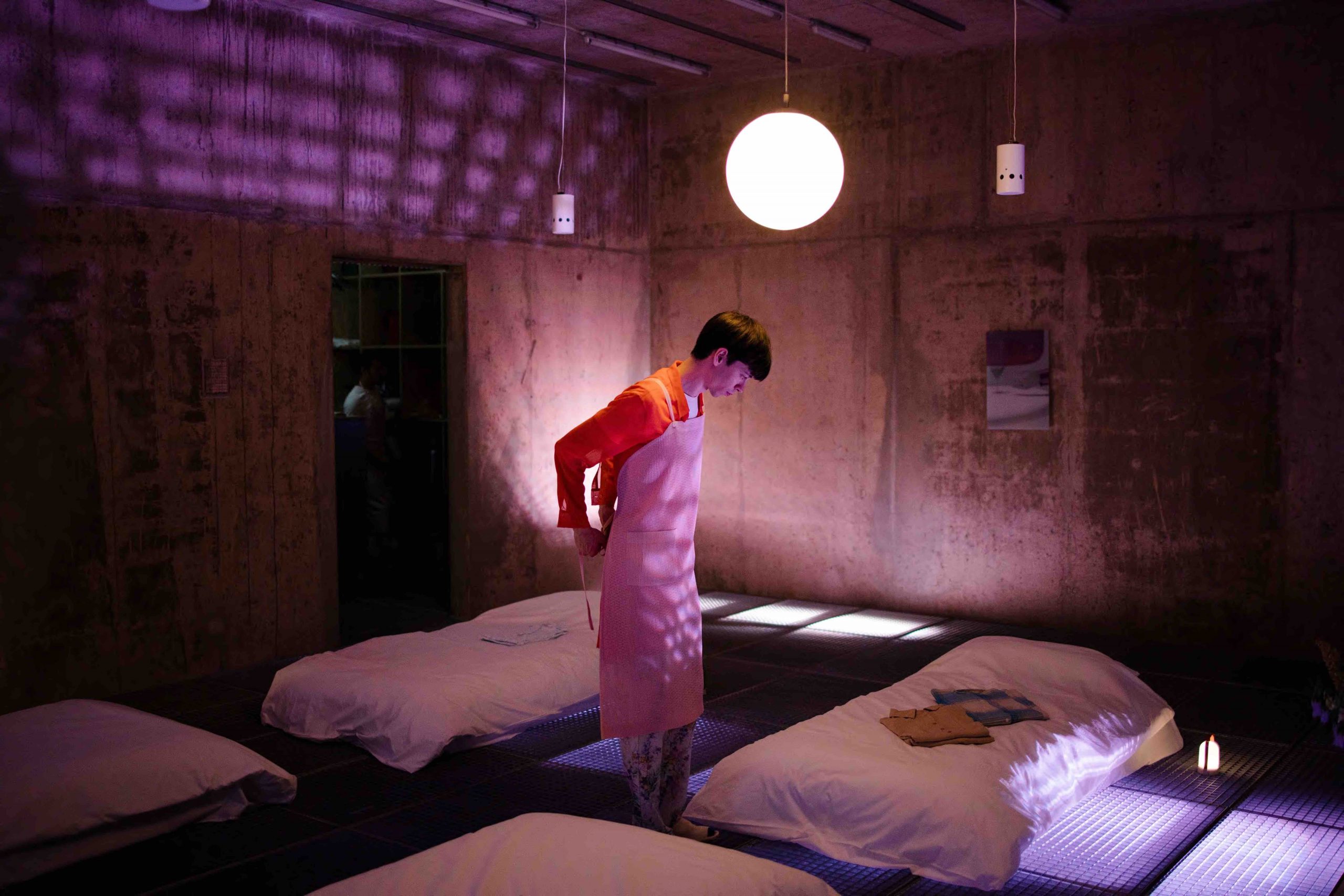
The latest piece of Steven Takasugi, Il teatro rosso, exhibits the attempt to raise the voice:
So here we have the singer, really put to the scene as the singer in the red theater of good old early culture industry amusement. And: She is raising the voice. So, it proves that it is possible to raise the voice in the present. The problem is she is most purely raising the voice, a bit too literally raising the voice, like just raising it. The voice is cut off, choked immediately after it is raised. The attack, the impulse is separated from what it is the impulse for. If raising the voice is about constituting expression, a tone, a melodic subject, and thus social relations, it fails, gets stuck from the beginning. And that doesn’t change for the hole piece, it is not a per aspera ad astra thing, in which the voice through the struggle establishes itself.
At the same time, everything makes clear that it is about the expressive bel canto situation, the theater, the facing of the audience – this is not chamber music, that, as Metzger said, is dedicated to the musicians, but is an attempt at addressing the public – a failed one.
Looking at the score, we learn that it is even supposed to be an „Aria“, and the instruction for the singer says „solo“ and „bel canto“.
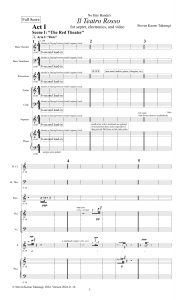
Steven Kazuo Takasugi, Il teatro rosso (2020-4) for septet, electronics and video, „work-in-progress-score“ v.2024.11.16, p. 1.
And there’s a vagueness to her short vocal points which is exposed by the fact that every note is so lonely and separated from the others: they seem to double. Sonically and visually the sounds don’t fully match the performers’ vocalisations, but singer and vocalisations hold a diffuse and questionable relation. The points are never really on point. The tones are isolated and lonely, but never alone – both in a poetic, but also analytically literal sense.
This is because there is a playback that the musicians aim to quasi match, while the playback is very close to what they play. So, there’s redundancy in both, the electronic playback and the vocalisations of the singer. The singer really is the source of the sounds she produces, but she wouldn’t need to, because they are played back anyway. And what is played back is really her past vocalisations, the material on the tape doesn’t invent some own electronic material sphere, but is just her voice, recorded in improvisations in the past. So here, we have a situation in which neither the voice is integrated in the electronics, nor does it control the electronics, not do they add up to something. In the opposite, voice and electronics, or say, live voice and dead voice, are in an unproductive relationship, their relation doesn’t create more than the sum of the parts, but less than the sum of the parts. They undermine each other but at the same time none of them would make sense without the other. Their relation makes a negative sense, pointing to the absence of musical sense.
There is a weird notion to the as-if-character that all art shares as appearance. Wagners mystical abyss, in hiding of the technical apparatus of the orchestra in the orchestra pit, aimed for the impression as if no labor would be necessary for the music to happen. This was turned around by Kagel, who in 1966 stated for his instrumental theater, that if anything, he would prefer to have the stage action hidden down in the orchestra pit and the musicians put up on the stage. [11] Thus making the labor visible, making transparent that labour is actually necessary for music. Now Takasugi takes a weird position in that. After Wagner’s phantasmagoria as if labor was necessary, and Kagels artistic employment of the fact that labour is necessary, Takasugi presents a situation such as if labor would be necessary. While it is not, because there’s the playback anyway.
This destructive dynamic escalates into crisis between 4’00“ and 7’00“ in the link above, after which the singer brings us back in the loop of the attempts to raise the voice. Of course, there are several formal and material aspects to that section, for example, the accumulation of the isolated pointillistic dots into a complex and chaotic sound mass – but we have to stay with the vocal. For that, surely it is notable that the way the single notes connect does, of course, not take the form of a melody, of something that can be sung. The sopranos vocalizations get flooded with their own electronic doubles, their own electronic past. She gets overwhelmed by the products of her own vocal activity. She tries to keep track, and is most virtuously doing so, but it is fully in vain: The sounds that she is the source of do not become an expression of her activity. She isn’t the subject of these sounds, even though she produces lots of sounds and also actually is the source of the sounds on the tape. The tension between her virtuous attempt to sing this most complex vocal part and the sonic result collapses: All her virtuosity is as heroic, as it is insufficient, and superfluous. It is insufficient, because she cannot keep up with the sheer mass of sound dots that the tape releases over her. And it is superfluous, because it doesn’t seem to make a difference what she does anyways – even though she does a lot.
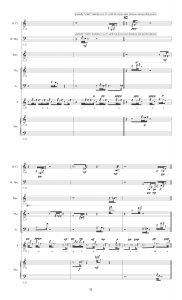
Steven Kazuo Takasugi, Il teatro rosso (2020-4) for septet, electronics and video, „work-in-progress-score“ v.2024.11.16, p. 31.
That develops into another potential. In a later section (about after 30′ in the video) she seems to give into this non-relation: Sometimes her vocalisations aren’t heard, sometimes they are, sometimes they are heard but she doesn’t produce them, sometimes she lipsyncs, sometimes it seems as if she actually really produces the sounds, even though she actually really produces them. She lets herself in for a relation to her own expression as not her own. She engages in and incorporates an expression that is not hers, but that she still can enjoy being part of. And again, she’s not just passive in that, she really is active, she really in a very disciplined and dedicated way works on that senseless beauty of incorporating an expression that is not her own.
And it is not a kind of constructive situation now that the electronics support the voice and the voice supports the tape. No, they still relate in the same destructive way of undermining each other. But there’s something in that destructive relation that seems enjoyable and that is expressive in giving up on the expression, on raising the voice. It might be that of a subject not only constituting itself toward the other, but also dissolving in the other, giving up the limitations of the constituted subject to freely unite with the object. Those bubble pop sounds suggest that fluidizing of the superflouos subject, transcending the limitations of the bubble. As with the accumulation of the dots in the music, in the video the accumulation of the image in the, so called, ‚infinity frame‘, also points to the possibility of transcendence of the accumulation of the ever same.
So it is not the claiming of subjectivity against the machine, also not the integration of the subject in the machine, but is giving in to their negative relation. She is raising the voice really, but not with an exclamation mark to transmit a given message, but as a problem, knowing that there is no message to transmit. She is raising the voice as the question for the possibility of raising the voice.
[1] G. W. F. Hegel: Vorlesungen über die Ästhetik [1818]. Bd. III, Frankfurt, Suhrkamp, p. 175: “the human voice can apprehend itself as the sounding of the soul itself, as the sound which the inner life has in its own nature for the expression of itself, an expression which it regulates directly.” (Aesthetics: Lectures on Fine Art, Vol. II, Oxford Univ. Press 1975, p. 922)
[2] Jean-Jacques Rousseau: Essai sur l’origine des langues où il est parlé de la mélodie et de l’imitation musicale [1754]: “as soon as vocal signs strike your ear, they announce to you a being like yourself. They are, so to speak, the voice of the soul. If you hear them in the wilderness, they tell you you are not there alone. Birds whistle; man alone sings. And one cannot hear either singing or a symphony without immediately acknowledging the presence of another intelligent being.” („Essay on the Origin of Language which treats of Melody and Musical Imitation“, Univ. of Chicago Press 1966, p. 63)
[3] Theodor W. Adorno: „Graeculus (1) Musikalische Notizen“ in: Frankfurter Adorno Blätter VII. (edition text+kritik 1992), p. 28: „Musik als Verdopplung. Wer singt ist nicht allein. Er hört eine Stimme, ein Anderes, was doch er selbst ist. Sich selbst zum Anderen werden, sich entäußern. Darin liegt eine Fülle von Momenten:
die Wendung gegen die Angst (wer Angst hat singt weil er dann nicht mehr allein ist)
die immanente Beziehung auf die Gattung. Kollektiv als Urphänomen. In der Musik bestimmt sich der Einsame als ein Subjekt und zugleich als anderes Subjekt. Der Bann der gebrochen wird ist zugleich der des bloßen Für sich seins.
die Objektivation. In der Verdopplung, dem Urphänomen von Reflexion – Echo! -, wird das Subjekt gegenständlich, allgemein und dadurch überhaupt erst Subjekt.“ [1962]
[4] Horkheimer, Max and Theodor W. Adorno: Dialektik der Aufklärung: Philosophische Fragmente [1944] (Dialectic of Enlightenment: Philosophical Fragments, Stanford University Press 2002, p. 27).
[5] Karl Marx, Das Kapital, Band I [1867] („Capital, Volume One“, The Marx-Engels Reader, New York, Norton & Company, p. 362–3). Here, Marx even determines the character of the „soul“ in the era of the industrial machine production, capitalism, as depersonalized – consequently, the voice in capitalism, other than in previous bourgeois society, that Rousseau and Hegel are concerned with, is not the expression of the person and its soul, but the expression of the soul of capitalism, which still is the expression of human activity, but human activity as absorbing itself: „As capitalist, he is only capital personified. His soul is the soul of capital . But capital has one single life impulse, the tendency to create value and surplus-value, to make its constant factor, the means of production, absorb the greatest possible amount of surplus-labour.“
[6] Richard Wagner, „Das Bühnenfestspielhaus in Bayreuth. Nebst einem Berichte über die Grundsteinlegung desselben“, SSD 9 (Breitkopf & Härtel, 1912), p. 337.
[7] Hegel considers therein the „absolute negation“ (absolute Negativität) of the Romantic art, and thus its potential, even of overcoming art itself: “In this pantheon all the gods are dethroned. The flame of subjectivity has consumed them.” (Vorlesungen über die Ästhetik, Bd. II, Suhrkamp p. 129, own translation differs from Aesthetics: Lectures on Fine Art, Vol I, 1975, p. 519). Only after Hegel’s time appeared the new God, capital to consume the flame of subjectivity itself, and thus to constitute a new potential of realizing and overcoming art.
[8] David Osmond-Smith, „The Tenth Oscillator“, Tempo v.51 n.227 (Jan. 2004): 4–5. Doi: https://doi.org/10.1017/S0040298204000014
[9] Cathy Berberian in an interview with Sylvana Ottieri, quoted in Kate Meehan, Not Just a Pretty Voice: Cathy Berberian as Collaborator, Composer and Creator, Washington Univ. St. Louis, ETDs 239, p. 80–1. Online: https://openscholarship.wustl.edu/etd/239. See also: Ibid. p. 57.
[10] Marion Saxer, „Kunstgesang als Klangsymbol: Belcanto in experimenteller Vokalmusik nach 1960“, Musik & Ästhetik v.23 n.92 (2019), p. 7.
[11] Mauricio Kagel, „Neuer Raum – Neue Musik: Gedanken zum Instrumentalen Theater“, Lecture at the Darmstadt Summer Course 1966, audio, Archive Internationales Musikinstitut Darmstadt (D-DSim), IMD-M-10880.